International Journal Publication
2T Perovskite Tandem Solar Cells in Space: Failure Mechanisms and Design Strategies
Author affiliations and roles
- aChang Gung University
- bMing Chi University of Technology
- cChang Gung Memorial Hospital
Materials Today Energy (2026).
Research topic: Space PV & Reliability
Abstract
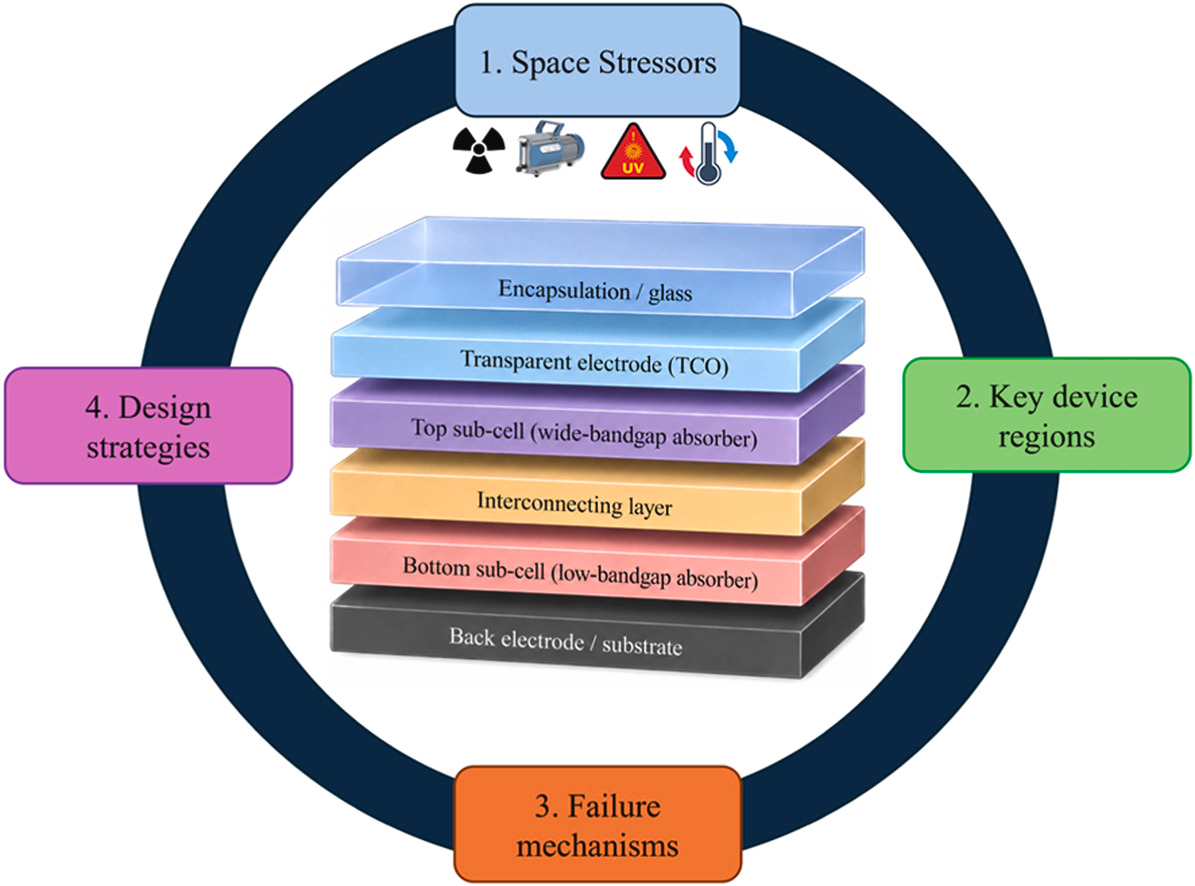
Perovskite tandem solar cells (TSCs) offer a promising route toward lightweight, high-efficiency space photovoltaics, but their multilayer architecture introduces degradation pathways beyond those of single-junction devices. This review examines the reliability of two-terminal (2T) perovskite TSCs under space-relevant stressors, including radiation, vacuum, atomic oxygen, ultraviolet exposure, thermal cycling, and low-intensity, low-temperature operation. The discussion is organized from stressor-specific degradation to layer-wise vulnerability, covering absorber instability, charge transport layer degradation, interconnecting layer (ICL) failure, bottom-cell damage, electrode diffusion, and encapsulation limitations. Since complete tandem studies remain limited, degradation trends are interpreted using tandem sub-cell data, single-junction analogues, and material-level studies. The review also highlights how current matching and buried ICL stability can convert localized degradation into full-device performance loss. Multiscale simulation methods are discussed as tools for linking radiation, thermal, and mechanical stress to device-level outcomes. Finally, design strategies for improving stability are summarized, including absorber composition tuning, interface passivation, robust ICLs, protective barriers, and mechanically compatible encapsulation. This review provides a reliability-focused framework for developing 2T perovskite TSCs for future space missions.
Highlights
- Perovskite tandem solar cells face unique reliability challenges in space.
- Radiation, vacuum, heat, and ultraviolet light create different failure paths.
- Damage in one layer can limit the whole solar cell by reducing current flow.
- Buried layers are critical weak points for long-term space operation.
- Better barriers, interfaces, and materials can improve stability in space.
Graphical Abstract