International Journal Publication
Exploring the efficiency enhancement of perovskite solar cells by chemical bath depositing SnO2 on mesoporous TiO2 electrode
Author affiliations and roles
- aChang Gung University
- bHong Kong Polytechnic University
- cChang Gung Memorial Hospital
- dMing Chi University of Technology
Materials Today Chemistry, 41, 102329 (2024).
Research topic: Perovskite Solar Cells
Abstract
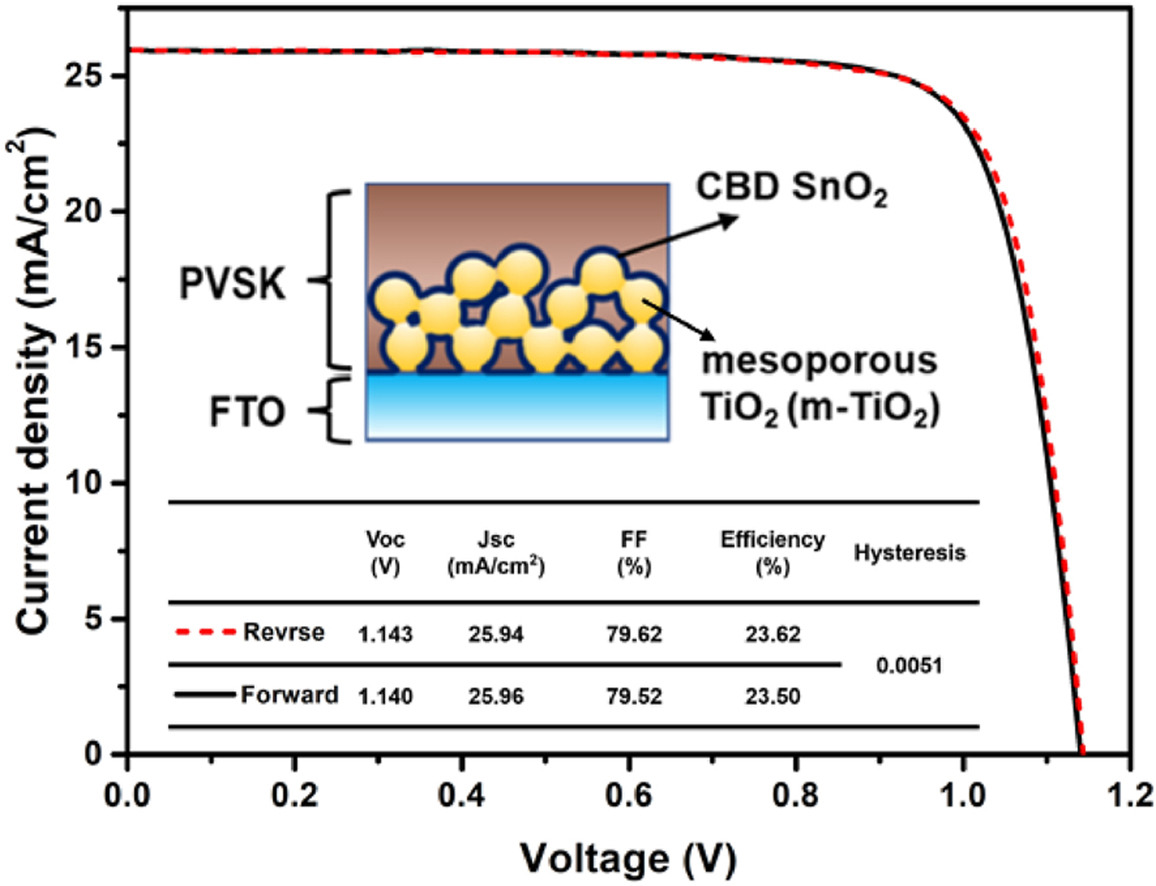
This study presents a groundbreaking approach to enhance the efficiency of perovskite solar cells (PSCs) by employing Chemical Bath Deposited (CBD) SnO2 on mesoporous TiO2 (m-TiO2) as an electron transport layer (ETL) without a traditional compact TiO2 (c-TiO2) layer between FTO (fluorine-doped tin oxide) and m-TiO2 ETL. Our investigation reveals that this method significantly improves carrier dynamics, as evidenced by reduced time constants compared to traditional ETLs. The CBD SnO2 not only augments electron transport but also effectively reduces defect density in m-TiO2 films. These enhancements are reflected in the improved photovoltaic parameters of the cells, including higher open-circuit voltage (V-OC), short-circuit current (J(SC)), fill factor (FF), and an impressive power conversion efficiency (PCE) exceeding 23.62 %. The study further underscores the scalability of this technology, highlighting advancements in screen printing and chemical bath deposition techniques vital for large-area PSC applications. Remarkably, the uniformity of PCE across large-area cells confirms the efficacy and consistency of this approach, which provides a new and general strategy for preparing high-efficiency PSCs.
Highlights
- The study introduces a novel ETL using CBD SnO2 on m-TiO2 enhancing carrier dynamics and reducing recombination.
- Integration of CBD SnO2 with m-TiO2 significantly increases key photovoltaic metrics, achieving a PCE of over 23.62%.
- Advances in screen printing and CBD methods allow this method to be scaled up effectively, maintaining PCEs between 21.75% and 23.52% across large areas.
- This work simplifies the PSC fabrication process, helping reduce costs while maintaining high efficiency.
Graphical Abstract
Keywords
OpenAlex citation history
Citations by year
- 02024
- 62025
- 32026
View citation counts as a table
| Year | Citations |
|---|---|
| 2024 | 0 |
| 2025 | 6 |
| 2026 | 3 |
OpenAlex citing works
Articles citing this work
9 citing articles with DOI, from 9 records indexed by OpenAlex.
Physical-Chemical Synergistic Interface Engineering via Mesoporous SnO2/Thiophene-Graphdiyne Heterostructure in Perovskite Solar Cells ↗
Langmuir · vol. 42, no. 33, pp. 24572-24580, 2026
Metal oxide and its modification as photoanode for dye-sensitized solar cell: a review ↗
Journal of Materials Science Materials in Electronics · vol. 37, no. 12, 2026
Recent Advances in Chemical Bath Deposition of Electron and Hole Transport Layers for Perovskite Solar Cells and Modules ↗
Rare Metals · vol. 45, no. 3, 2026
DOI: 10.1002/rar2.70160
Surface and Interface Engineering of Tin Oxide Electron Transport Layers: Recent Progress and Perspectives for Perovskite Photovoltaics ↗
Applied Science and Convergence Technology · vol. 34, no. 6, pp. 177-183, 2025
Beyond structural and electronic benchmarks: A hybrid DFT+U and AIMD study of β-CuSCN 's mechanical properties, elastic anisotropy, charge distribution, optical response and thermal resilience for PSCs ↗
Materials Today Chemistry · vol. 48, pp. 103021, 2025
Minimizing Buried Interface Energy Losses via Urea Phosphate Derivatives Enable High‐Efficiency Carbon‐Based Mesoscopic Perovskite Solar Cells ↗
Small · vol. 21, no. 38, pp. e07384, 2025
A review of metal oxide semiconductors: Progress in solution-processed photovoltaic technologies ↗
Journal of Alloys and Compounds · vol. 1024, pp. 180207, 2025
Fluorene-bridged viologen derivatives exhibiting strong fluorescence and electrochromic properties ↗
Materials Today Chemistry · vol. 45, pp. 102697, 2025
Designing Furan and Quinacridone-Based Htms for Superior Charge Transfer and Enhanced Efficiency in Perovskite Solar Cells ↗
SSRN Electronic Journal · 2025
DOI: 10.2139/ssrn.5278731